Blog

What Are the Top 10 Display Flag Manufacturers in China?

Choosing a Display Flag manufacturer in China involves more than comparing prices. Fabric weight, print clarity, stitching, and finishing all affect how a flag looks outdoors. A vivid sample can still disappoint if its pole pocket twists or its edges fray after repeated use. Small details matter.

For a practical sourcing perspective, this guide uses an illustrative industry voice: Lin Wei, a composite display-flag production adviser. The guiding quote is: “A reliable flag is judged by its details after production, not by the mockup alone.” It is a useful reminder, though not a substitute for factory evidence. Ask for recent samples, confirm material specifications, and check how each supplier handles proofing and quality control.

The companies featured in this Top 10 overview are presented as candidates to compare, not as a universal ranking. Buyers should weigh product range, customization, communication, order requirements, and delivery planning against their own needs. A supplier strong in feather flags may not be the best fit for a large event backdrop. There is no perfect checklist. Even careful research leaves room for uncertainty, so verify claims directly before placing an order.

What Are the Top 10 Display Flag Manufacturers in China?

Define Display Flags: Common Formats, Polyester Fabrics, and Printing Methods

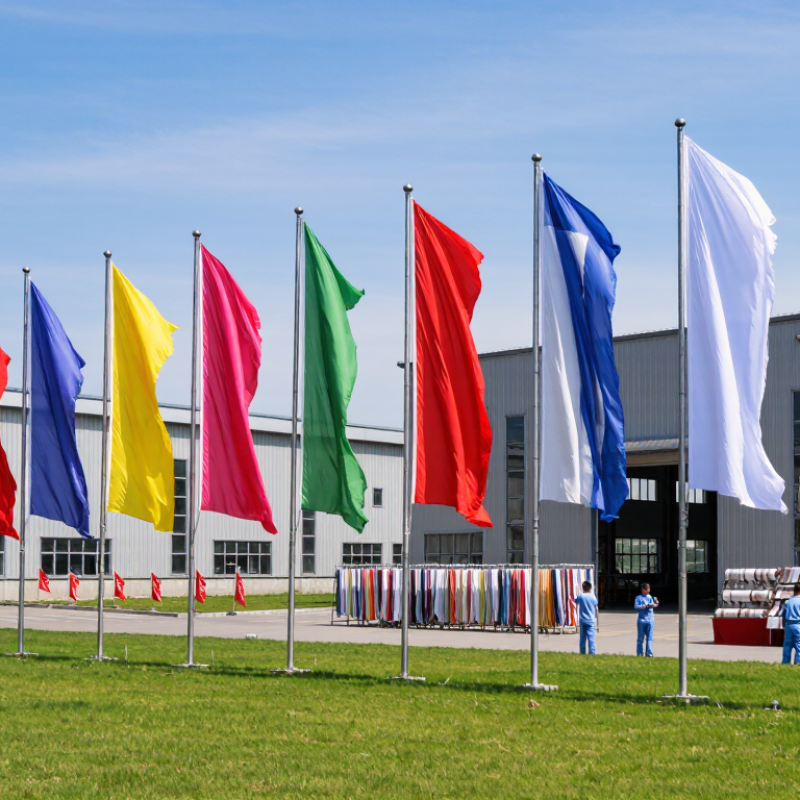
Display flags are lightweight signs designed to move with the air and attract attention from a distance. Common formats include feather, teardrop, and rectangular flags. Feather flags have a curved outer edge; teardrop flags keep fabric taut near the top. Rectangular versions offer a broad, familiar surface. Check the finished height, base type, and indoor or outdoor use before choosing a format. Small details matter.

Polyester is widely used because it is light, dries relatively quickly, and accepts vivid graphics. Knitted polyester can drape and flutter, while tighter weaves may give a smoother print surface. Printing methods include dye sublimation, which transfers color into polyester fibers, and direct digital printing, which applies ink to the fabric. Results depend on fabric construction, ink, and finishing, so samples are worth reviewing.

Look closely at fine text and color consistency. They can vary. A flag meant for a windy site also needs suitable stitching and a stable pole; fabric alone cannot prevent wear. Even a well-made sample may not predict months of exposure, so durability claims deserve a little skepticism.

Compare 10 Chinese Manufacturers by Product Range, Capacity, and Export Markets

China’s display-flag manufacturers vary in product range, production capacity, and export reach. The WTO’s World Trade Statistical Review 2023 reports that China supplied about 42% of global textile exports in 2022. This figure covers textiles broadly, not flags alone, so use it as supply-chain context—not proof of a factory’s flag-making capacity. A useful comparison of ten manufacturers should check fabric choices, printing methods, finishing options, and indoor or outdoor formats.

Capacity needs more than a headline number. Ask for monthly output, minimum order quantities, sample lead times, and how orders are checked for color consistency. Compare export experience by asking which regions a supplier serves and whether it can provide shipment references. A wide catalog can look impressive, but it may not mean every option is produced in-house. I would verify that point.

Tips: Request recent product samples and a written specification for fabric, dimensions, stitching, and packaging. Compare like with like. A fast quote can still leave important details unclear.

Top 10 Chinese Display Flag Manufacturers: Comparable Public Data

Product range, production capacity, and export markets

Company-level figures are left blank because comparable, independently verifiable data for these metrics is not provided here. Blank values do not indicate zero capacity or no exports.

Check Flag Fabric Specs: Typical 100–120 g/m² Polyester and Material Options

When comparing ten Chinese display-flag manufacturers, check the fabric specification before judging a sample photo. A common outdoor option is 100–120 g/m² polyester, light enough to move in a breeze and practical for printing. GSM means grams per square metre; it does not, by itself, prove durability.

Ask whether the quoted weight applies to the base fabric and whether the supplier can provide a swatch. Feel the edge. A fabric that seems sturdy indoors may behave differently on a windy street.

Knitted polyester is often chosen for its flexibility and airflow, while woven polyester can feel more structured. Mesh polyester may suit exposed locations, though fine details can look less crisp through its openings. For indoor displays, satin-like polyester offers a smoother sheen, but glare may affect readability.

Recycled polyester is another option; confirm its composition and request relevant documentation rather than relying on a label alone. Ask how the fabric works with the proposed printing method, and check a printed sample for color, translucency, and seam quality.

Small differences matter. One thing buyers can overlook is the finished flag’s hem: fabric strength cannot compensate for weak stitching. Compare written specifications, sample results, and intended use, then make a judgment—not every “premium” claim deserves equal weight.

Evaluate Print Durability: Lightfastness Testing Under ISO 105-B02

For buyers comparing China’s top display flag manufacturers, lightfastness deserves more than a sales claim. Sunlight can fade a flag unevenly: the exposed edge may pale while fabric near the pole stays vivid. ISO 105-B02:2014 describes xenon-arc testing for colour fastness to artificial light, using blue-wool references graded from 1 to 8. Higher ratings indicate better resistance under the specified test conditions. A grade is useful evidence, not a promise of identical outdoor life; weather, fabric weight, and printing method all affect performance.

Ask suppliers for the full test report, not only a rating. Check the tested fabric, ink system, exposure conditions, and whether the sample was printed and finished like the production flag. Compare equivalent samples across manufacturers. Small details matter. One limitation is easy to overlook: a laboratory swatch cannot fully reproduce wind, rain, or a flag’s constant movement. Buyers should treat test data as a comparison tool, not a complete prediction.

Tips: Request a recent ISO 105-B02 report from an accredited laboratory. Confirm the rating applies to the actual printed material, then inspect a sun-exposed sample for fading and colour shifts. A clear paper trail helps; it still cannot replace field checks.

What Are the Top 10 Display Flag Manufacturers in China? — Evaluate Print Durability: Lightfastness Testing Under ISO 105-B02 Manufacturer evaluation framework: compare documented testing and sample performance rather than treating unverified supplier claims as rankings.
No. Evaluation dimension Verifiable benchmark Evidence to request How to interpret it
1 Lightfastness test standard ISO 105-B02 evaluates colour fastness to artificial light using a xenon-arc light source. A test report identifying ISO 105-B02, the tested material, colour and method used. A general statement such as “UV resistant” is not a substitute for a standard-specific report.
2 Blue Wool reference scale The Blue Wool scale runs from 1 (lower lightfastness) to 8 (higher lightfastness). The reported Blue Wool reference and the result or endpoint for each tested sample. Use the scale to compare reported results; do not treat it as a guaranteed outdoor service-life rating.
3 Tested flag construction Lightfastness results apply to the specimen tested, including its fabric, print method and colour. Sample description listing fabric composition, fabric weight, print process and ink or dye system. A result for one fabric or print configuration should not automatically be applied to another.
4 Colour-by-colour performance Different colours in a design can fade at different rates under light exposure. Results for representative colours, especially the most light-sensitive colours in the artwork. A single result for a neutral or dark shade does not establish performance for every colour.
5 Exposure and evaluation details ISO 105-B02 includes defined exposure and assessment procedures; the selected method and endpoints matter. The full report, including method details, exposure conditions and the assessment basis. Compare samples only when the test method and reporting basis are sufficiently alike.
6 Sample traceability A meaningful report should be traceable to the specimen and production configuration it covers. Sample identification, test date, report number and confirmation of who performed the test. Traceability helps establish whether the report relates to the proposed production sample.
7 Laboratory and report verification Test conclusions should be supported by a complete, identifiable laboratory report. Laboratory name, report number and, where relevant, current accreditation details and scope. Verify report details with the issuing laboratory when the result is important to the purchase.
8 Production consistency A tested sample is evidence about that sample, not automatic proof that every production batch will match. Documented colour-control process, approved production sample and batch inspection records. Ask how the supplier controls fabric, printing and finishing changes between orders.
9 Other durability requirements Lightfastness is distinct from properties such as wash fastness, rubbing fastness and weather resistance. Separate test results matched to the intended use and cleaning or exposure conditions. Choose additional tests based on the flag’s actual use; one test does not establish all durability properties.
10 Outdoor-use claims ISO 105-B02 light exposure results alone do not specify a universal number of days or months outdoors. Written claim conditions covering location, orientation, climate, maintenance and any warranty limits. Actual service life depends on exposure and use conditions; request evidence for any specific lifetime claim.
Note: This table is a neutral comparison checklist, not a verified ranking of Chinese manufacturers. No supplier-specific scores or test results are assigned without comparable, verifiable reports.

Match Suppliers to Use Cases: Outdoor Wind Exposure, Indoor Displays, and Events

Choosing among display flag manufacturers in China starts with the setting, not the catalogue. Outdoor flags need sturdy stitching, secure pole sleeves, and bases suited to the ground. Ask how the complete setup performs in wind, and what conditions any test covered. A heavy base can help on pavement, while a ground stake may suit grass. Neither option makes a flag suitable for every gust. Check fabric durability and replacement-part availability, too.

Indoor displays face different demands. Color consistency, neat edges, and a stable base matter more than wind resistance. Under bright showroom lights, thin fabric can look washed out, so request a sample and inspect it under similar lighting. Measure the stand’s footprint before ordering; crowded aisles leave little room. Small details matter.

Events bring tight schedules and frequent handling. Look for suppliers who can confirm production timing, packing dimensions, and setup instructions in writing. A lightweight kit is easier to carry between venues, but overly light hardware may wobble on uneven floors. Ask whether printed panels can be replaced without buying a whole new stand. One thing is easy to miss: sample quality may not reveal how a product holds up after repeated use. Check the finish, seams, and connectors after assembly, then match those details to your expected workload.

Article Source: