
Prefinished plywood combines a structural panel with a factory-applied surface, helping buyers reduce on-site finishing work. Demand depends on more than appearance. Core construction, veneer quality, coating durability, and consistent thickness all affect performance in furniture, cabinetry, and interior fit-outs. The FAO’s Global Forest Products Facts and Figures 2023 identifies China as the world’s largest producer of wood-based panels. That scale gives global buyers a broad supplier base, but production volume alone does not prove quality or reliability. Details vary.
This guide to China’s top 10 prefinished plywood suppliers helps buyers compare capabilities, product ranges, and export readiness. The FAO’s forest-products statistics and ITTO’s market reporting offer useful context on panel production and trade. For company-level checks, buyers can also review shipment information through UN Comtrade, while recognizing that trade codes do not always isolate prefinished plywood as a separate category. Ask suppliers for current technical data sheets, sample panels, test reports, and clear descriptions of substrate and finish. Check whether stated emissions and performance claims match the requirements of the destination market. Small differences matter: a gloss sample under showroom lighting may not reveal color variation across a full production batch. No supplier is a perfect fit for every project. Use the shortlist as a starting point, then verify claims directly and test samples against the intended application.
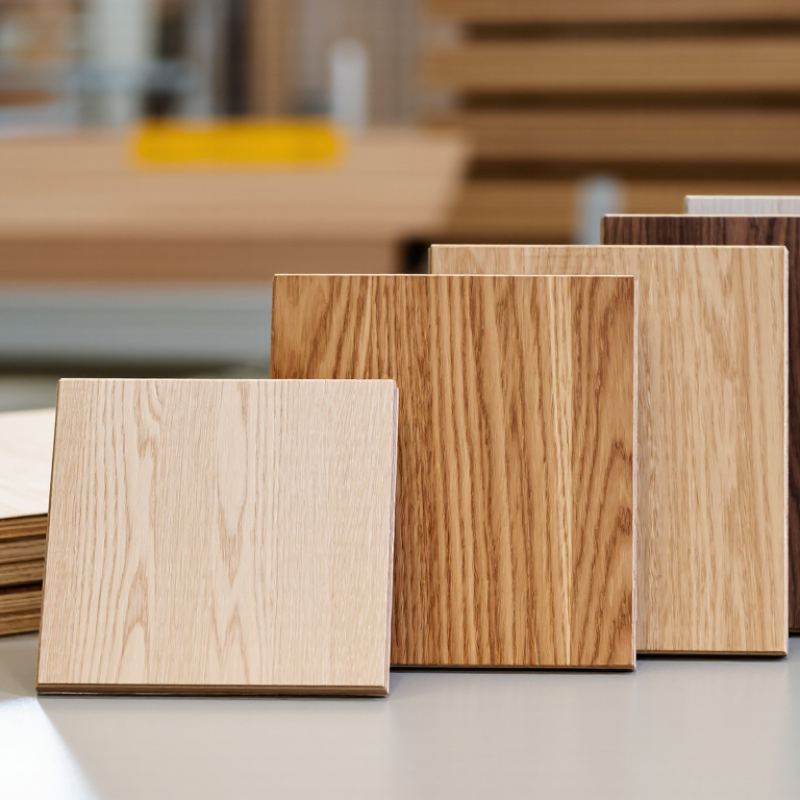
Prefinished plywood combines a decorative face veneer with a factory-applied coating, reducing sanding and finishing work on site. That saves time. Veneers may show open grain, subtle color shifts, or small natural marks; a sample helps set realistic expectations. Core options commonly include veneer, MDF, and particleboard, each with different weight, screw-holding behavior, and edge appearance. Feel the edge. Check the product data sheet for core construction, thickness tolerance, and recommended use, because product descriptions do not always explain every layer clearly.
Finishes range from matte to gloss and may include clear coatings or colored surfaces. A matte face can hide fingerprints better, while a glossier one may reveal scratches under strong light. For cabinetry and interior panels, confirm whether the finish is suitable for the expected cleaning routine and exposure. Many panels are supplied in 4 × 8 ft sheets, but actual dimensions and squareness can vary slightly. Measure twice. Before ordering, compare samples in the room’s lighting and inspect both faces and edges. I would not assume that “prefinished” means ready for every application; machining, exposed edges, and site conditions can still affect the final result.
TSCA Title VI sets a formaldehyde emission limit of 0.05 parts per million for hardwood plywood sold in the United States. The U.S. EPA’s 2016 final rule established this benchmark for composite wood products. Testing uses chamber methods, including ASTM E1333, with controlled temperature, humidity, and air exchange. Small number. Big consequence. For global buyers comparing prefinished plywood suppliers, request current test reports and check that the product category matches hardwood plywood—not MDF or particleboard, which have different limits.
The limit describes emissions measured under a specified test; it is not a prediction of a room’s formaldehyde concentration. That distinction matters when panels are cut, edge-treated, or installed beside other materials. EPA’s TSCA Title VI compliance guidance also addresses third-party certification, recordkeeping, and product labeling. Buyers can ask for the certifier’s details, report date, tested construction, and applicable production lot. A polished surface may look reassuring, but appearance cannot verify emissions. Nor does one test necessarily represent every later batch. There is room for uncertainty here: documents should be checked against the actual panel, finish, and shipment, not accepted as paperwork alone.
For global buyers, supplier checks should go beyond a polished catalog. Request current certificates and confirm their scope, expiry dates, and issuing bodies. Verify that the documents cover the actual factory and prefinished plywood products under discussion. Ask for panel test reports, including formaldehyde emissions and surface durability, where relevant to your market. Paperwork can mislead.
Capacity needs practical evidence. Ask how many press and finishing lines are operating, what sizes they handle, and how much production is already booked. Monthly output figures are useful, but compare them with recent order records or a factory audit. A sample proves finish, not throughput. That distinction matters when a supplier promises a large shipment during a busy season.
Clarify minimum order quantities by thickness, grade, finish, and panel size. Some suppliers allow mixed specifications in one container; others require separate production batches. Get this in writing. Confirm lead times from deposit, approved sample, or final artwork—these starting points differ. Ask whether veneer sourcing, sanding, coating, inspection, and packing are included in the quoted schedule. Keep freight time separate from factory time, and allow room for rework. A detailed schedule may still slip; that possibility deserves a clear conversation before payment terms are agreed.
Buyer’s screening benchmark—not a verified supplier ranking. Supplier-specific certifications, production capacity, minimum order quantities, and lead times must be confirmed directly and supported by current documents. The ranges below are indicative planning guidelines, not guaranteed market-wide figures.
| No. | Assessment dimension | What to request or check | Useful benchmark or verification method | Buyer’s risk signal |
|---|---|---|---|---|
| 01 | Legal identity and factory status | Request the Chinese business licence, registered business scope, factory address, and confirmation of whether the exporter is the manufacturer or a trading company. | Match the legal entity on the quotation, contract, bank account, and export documents. Arrange a live video audit or independent factory inspection. | Different legal names appear on payment and contract documents without a clear, documented explanation. |
| 02 | Product specification | Confirm plywood species or core type, face veneer, adhesive, grade, thickness, dimensions, sanding, coating system, and edge treatment. | Use a signed product specification and an approved reference sample. State tolerances and inspection methods in the purchase contract. | Descriptions rely on broad terms such as “premium” or “E0” without a defined test method or measurable specification. |
| 03 | Emissions and product compliance | Ask for current test reports for the exact product construction, including the panel, adhesive, and intended destination market. | Check which formaldehyde-emission requirement applies in the destination market. For example, U.S. TSCA Title VI requirements apply to covered composite wood products; verify the applicable product category and documentation. | A report is expired, cannot be matched to the quoted product, or comes from a laboratory whose accreditation and scope cannot be confirmed. |
| 04 | Forest and chain-of-custody claims | If FSC or PEFC sourcing is required, request the certificate code and verify its status, scope, and product coverage in the relevant certification database. | A certification claim should be supported by a valid chain-of-custody certificate and correctly documented sales and delivery records where applicable. | A supplier displays a logo or certificate image but cannot provide a verifiable certificate number or show that the product is within scope. |
| 05 | Quality management | Request the quality-management certificate, audit scope, inspection plan, and recent records for incoming veneer, bonding, finishing, and final inspection. | Verify certificate validity and scope with the issuing certification body. Ask how nonconforming panels are identified, reworked, or rejected. | Quality claims are not backed by documented checks, acceptance criteria, or traceable batch records. |
| 06 | Production capacity | Ask for monthly output specifically for the required prefinished product, current order book, number of relevant production lines, and evidence of recent shipments. | Assess capacity against your forecast rather than relying on a factory’s total plywood output. Confirm available capacity and materials for the proposed production window. | The quoted capacity covers all product types, but the supplier cannot explain the portion available for your specification. |
| 07 | Minimum order quantity | Request MOQ by thickness, finish, size, and colour, and ask whether mixed specifications can be combined in one order. | MOQ is product- and production-line-specific; confirm whether it is measured per SKU, batch, container, or shipment. Include sample and trial-order options in the quotation. | The MOQ changes after sampling or excludes setup, colour-matching, packaging, or other charges that were not disclosed. |
| 08 | Lead time and delivery planning | Separate sample preparation, material procurement, production, inspection, and port delivery dates. Ask what starts the lead-time clock. | Request a written production schedule tied to order confirmation, deposit, and approved sample. Treat transit time and customs clearance as separate from factory lead time. | Only a single delivery estimate is provided, with no milestones or allowance for holidays, material shortages, or inspection. |
| 09 | Inspection and acceptance | Agree on inspection timing, sampling method, panel measurements, surface appearance, coating consistency, packaging, and remedies for failed lots. | Use a written inspection checklist and, where appropriate, an independent pre-shipment inspection. Define acceptance criteria before production begins. | Inspection is limited to supplier-selected photos, or the contract does not define what happens if the goods fail agreed specifications. |
| 10 | Export, packaging, and landed cost | Confirm Incoterms® 2020, port, packing method, loading plan, shipping marks, document set, and responsibility for export and import charges. | Compare like-for-like quotations and calculate landed cost. Confirm packaging suitability for the route and verify any destination-specific wood-packaging requirements. | The quotation omits key charges or responsibilities, or the shipping documents do not match the contract and packing list. |
China’s prefinished plywood suppliers differ in coating options, core construction, and export capabilities. Common ranges include melamine-faced panels for cabinets, veneer-finished sheets for furniture, UV-coated surfaces for interiors, and film-faced plywood for construction. Buyers should compare face thickness, core species, adhesive class, and edge quality—not just the finish shown in a sample. A glossy panel can hide uneven sanding. That matters.
China’s National Forestry and Grassland Administration reported about 346.7 million cubic metres of wood-based panel production in 2023, including roughly 208.9 million cubic metres of plywood. This scale supports varied supplier profiles: large manufacturers may offer broad specifications and steady volumes, while smaller specialists may handle custom dimensions or short runs. Figures describe the wider sector, not prefinished plywood alone. For a top-ten comparison, assess sample consistency, production lead times, moisture control, and documented quality systems. Request test reports for the exact panel construction being quoted; generic certificates are less useful. One limitation remains: supplier capacity claims can be difficult to compare without factory audits or recent production records.
These are common plywood panel formats found in export markets, not supplier-specific specifications or a ranking. Confirm available dimensions and prefinished options directly with suppliers.
For prefinished plywood, confirm the grade against the actual use, not just a catalogue description. Face quality, core construction, thickness, and finish tolerance should be stated in writing. Ask for the applicable grading standard and a sample from the production lot. Check the surface under neutral light; gloss can hide sanding marks, while raking light reveals dents and uneven coating. Small details matter. A sample is useful, but it does not guarantee every sheet will match.
Agree on inspection points before production: moisture readings, panel dimensions, edge condition, bonding, and finish consistency. Define the sampling method and who records results. Photos help, though they cannot replace physical checks. This is where buyers sometimes leave too much vague. Specify packaging, container loading, and protection against corner damage. Compare shipping terms carefully, including who arranges freight, insurance, and destination handling. Request the commercial invoice, packing list, bill of lading, and any required origin or quality documents before dispatch. Document names and import requirements vary by destination, so verify them with your customs broker. Keep the approved sample and inspection records on file; they make later disputes easier to examine.

Signup our newsletter to get update information, promotion or insight.