China Top 10 Bar Height Tables Manufacturers?
Choosing among China’s leading Bar Height Tables manufacturers takes more than comparing catalog photos. A tall table should feel stable, suit the intended stool height, and withstand daily use. Small details matter: a foot gliding across tile, a neat weld, or an edge that resists chips. Looks matter, too. But not alone.
Industrial designer Dieter Rams offered a useful principle: “Good design is as little design as possible.” Applied to bar-height furniture, this means checking whether a table’s shape, materials, and construction serve real use, not decoration alone. Ask practical questions. What are the frame and tabletop made of? Can the supplier provide clear dimensions, finish samples, production photos, and packaging details? Are custom sizes available, and how are defects handled? Request evidence, not just promises.
This guide introduces ten Chinese manufacturers for buyers to compare. Treat any ranking as a starting point, not a verdict. Review each company’s product range, export experience, customization options, quality-control process, and communication. A polished showroom image cannot confirm long-term stability. A low quote may leave important details unclear. Some information can be difficult to verify from public pages; that uncertainty deserves attention. By checking specifications and requesting samples where practical, readers can make a more informed shortlist of Bar Height Tables for cafés, restaurants, hotels, or homes.
What Defines a Bar-Height Table and Its Main Types
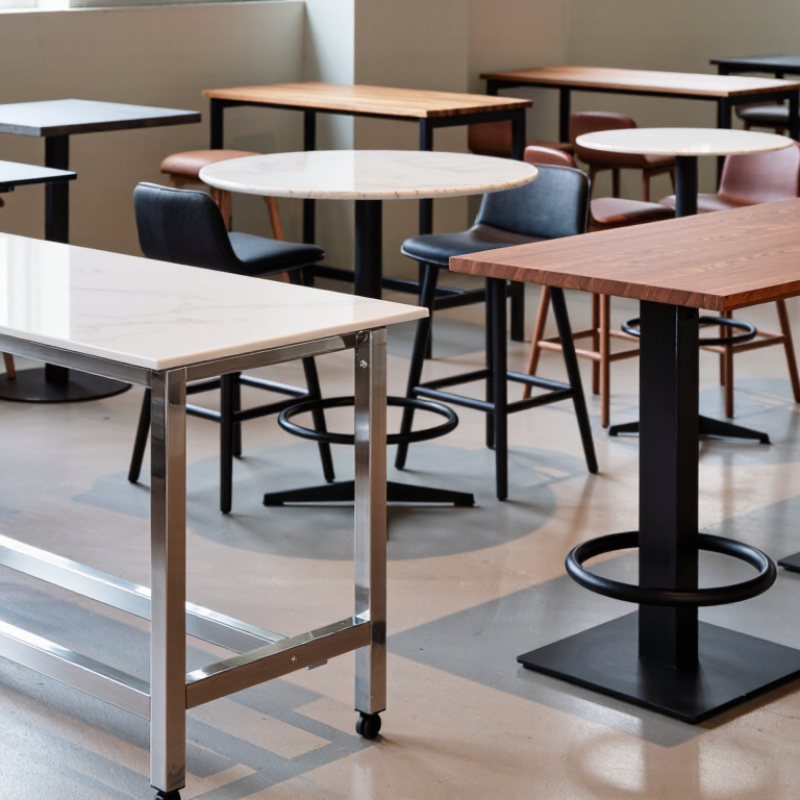
A bar-height table is defined by its working surface, usually about 40–42 inches (102–107 cm) above the floor. This is taller than a standard dining table and generally pairs with stools whose seats are around 28–30 inches high. Neufert’s Architects’ Data offers ergonomic planning dimensions, while ANSI/BIFMA X5.5-2021 sets performance tests for tables rather than prescribing one universal height. That distinction matters when comparing manufacturers: a familiar height is a convention, not proof of comfort or quality. Measure the stool, footrest, and tabletop together.
The main types include pub tables, counter-height tables, and adjustable-height models. Pub tables commonly use a compact round top, useful in a small café corner; rectangular versions suit shared seating or narrow dining areas. Counter-height tables sit lower, often near 34–36 inches, and can align with kitchen counters. Adjustable models offer flexibility, but their mechanisms add parts that need careful inspection. Check for wobble, stable leg connections, and enough knee clearance. A few inches can change the whole experience. In practice, room layout and intended seating matter as much as the label “bar height”—and product descriptions do not always make that clear.
How to Evaluate Bar-Height Table Manufacturers in China
China Top 10 Bar Height Tables Manufacturers?
How to Evaluate Bar-Height Table Manufacturers in China
Choosing a manufacturer takes more than comparing prices and catalog photos. Grand View Research valued the global furniture market at USD 541.52 billion in 2023 and projected 5.3% annual growth from 2024 to 2030. That broad market figure does not prove a supplier can make stable bar tables. Ask for production records, material specifications, and inspection results for the exact model you plan to order. Details matter. Check tabletop thickness, base dimensions, weld consistency, and the finish around drilled holes. These small details can reveal rushed production.
Request a pre-production sample and test it on an uneven floor. Apply a measured load, check for wobble, and inspect the table after repeated assembly. Ask how the factory controls moisture in wood components and protects metal parts during shipping. A certificate alone is not enough; verify its scope and issuing body. Ask for recent inspection reports, defect rates, and packaging photos from completed orders.
Ask for proof.
Compare quoted lead times with actual production schedules, and confirm how changes are recorded. Supplier documents can be inconsistent, so clarify unclear figures in writing. A polished sample is useful, but it may not represent every unit in a full shipment.
Ten Notable Bar-Height Table Manufacturers in China
China’s bar-height table sector includes manufacturers with very different strengths. A useful shortlist of ten notable supplier profiles spans solid-wood workshops, steel-frame producers, compact-space specialists, hospitality furniture makers, outdoor-table factories, custom-order manufacturers, ready-stock suppliers, stone-top producers, adjustable-height specialists, and mixed-material workshops. These descriptions are categories, not company names; capabilities vary by factory.
For a café, inspect welded joints, tabletop edges, and how the base handles a gentle side push. Ask about wood moisture control, coating thickness, replacement parts, and carton protection. A table can look sturdy in a photo yet wobble on an uneven floor. Details matter. For outdoor use, request clear information about finishes and exposure limits rather than assuming “weather-resistant” means suitable for every climate.
Before comparing quotations, share the intended setting, table dimensions, expected daily use, and order quantity. Request a sample or recent production photos when practical. Some suppliers are flexible with custom sizes but have longer lead times; others ship quickly with fewer options. That distinction is easy to miss. No single manufacturer fits every project, and a low unit price may not include packaging or delivery costs.
These typical furniture-planning ranges distinguish bar-height tables from dining and counter-height tables. Actual product dimensions vary by design; inch-to-centimeter conversions are approximate.
Comparing Materials, Designs, and Customization Options
When comparing China’s top bar-height table manufacturers, look beyond catalog photos. Materials shape durability, weight, maintenance, and price. Solid wood brings visible grain and can be refinished, but its tone may vary between batches. Powder-coated steel offers a slim, sturdy base; inspect welds and coating coverage near the footrest. Engineered-wood tops with laminate are often easier to clean, though exposed edges can swell if moisture gets in. Small details matter.
Design affects everyday comfort. Check the listed table height against the stools you plan to use, and ask whether the base leaves enough knee space. Custom options may include tabletop dimensions, edge profiles, finishes, base shapes, and cable openings. Ask for evidence. Request material specifications, finish samples, packaging details, and a pre-production sample when the order is substantial. A sample can reveal color differences that a digital image hides. Compare lead times and minimum order quantities alongside price, not after choosing a supplier. One imperfect point: even a carefully approved sample cannot guarantee every production unit will look identical. Clear tolerances and written inspection criteria make that risk easier to manage.
How to Choose a Manufacturer for Your Project
Choosing a bar-height table manufacturer starts with the project, not a ranking. Confirm the finished height, tabletop dimensions, base footprint, and expected daily use. A café needs different stability and wear resistance than a lightly used home bar. Ask what materials are used, including tabletop core, edge treatment, steel thickness, and coating. Details matter. A polished sample may look convincing, but the underside and welds deserve inspection too.
Request a production sample or a clearly documented pre-production unit. Check that the table stands level on a hard floor and does not wobble when pushed near the edge. Ask how the manufacturer tests load capacity and checks finish consistency across a batch. Get written specifications, tolerances, packaging details, minimum order quantities, and realistic lead times. Ask for recent inspection records or photos from comparable production, while remembering that photos cannot replace a physical check. Ask for proof.
Communication is part of quality control. Send a drawing with measurements and mark any custom changes, such as footrests, cable openings, or nonstandard colors. Compare quotations against the same specification; a lower price may exclude stronger hardware or protective packaging. Clarify who handles defects and replacement parts before placing an order. One thing is easy to miss: a small finish variation may be acceptable in one setting and obvious under bright restaurant lighting. I would also allow extra time for revisions; schedules often look cleaner on paper.