
Buying condiment bottles by the case can reduce unit costs, but the quoted price rarely tells the whole story. A Glass Condiment Bottle should suit the recipe, filling method, storage space, and customer’s grip. That sounds simple. Yet buyers sometimes compare capacity and color first, then discover that the neck finish will not fit their caps or pourers. A sample filled with the actual sauce can reveal awkward pouring, staining, or a label that wrinkles around the bottle’s curve. These details matter.
Before requesting quotes, record the bottle volume, glass weight, opening size, closure type, and estimated order quantity. Ask suppliers how they protect bottles during shipping and whether they can provide relevant food-contact material information. Compare landed costs, including packaging, freight, breakage allowances, and any setup fees. A low unit price may be less attractive when cartons arrive poorly packed or replacement stock takes weeks. Ask about production lead times, reorder consistency, and sample availability. Keep written specifications, so different suppliers are being compared on the same basis.
There is no single bottle design that works perfectly for every sauce. A wide opening may help with thick chutney, while a narrow neck can make pouring cleaner for thin dressings. Trade-offs are easy to overlook when buying in bulk. The tips below focus on practical checks, supplier questions, and cost details that help reduce avoidable surprises before a large order is placed. A little testing now can prevent a storeroom full of bottles that almost fit.
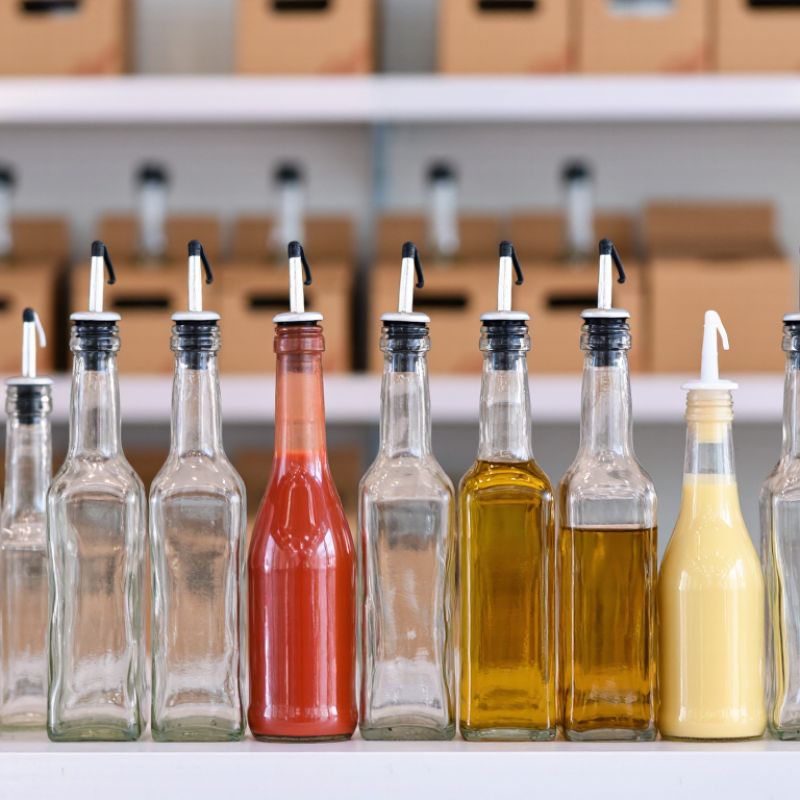
Before requesting bulk quotes, define the bottle’s job. A 250-milliliter table sauce bottle needs different proportions from a narrow-neck oil bottle. Specify capacity, height, maximum diameter, glass color, neck finish, and target fill level. Include the cap or pourer requirements, since a small mismatch can cause leaks or slow filling. Small details matter.
Record the product’s thickness and flow, too. A chunky relish may need a wider opening than a smooth dressing. Ask suppliers for dimensional tolerances, case-pack counts, pallet patterns, and estimated breakage rates. Then test filled samples on your actual filling line and during transport. Do not rely on drawings alone. A first specification can still be wrong; revise it after checking how bottles pour, stack, and survive handling.
End-of-life needs belong in the brief as well. The U.S. EPA’s 2018 Advancing Sustainable Materials Management report estimated 12.3 million tons of glass containers were generated, with 3.1 million tons recycled. That is about 25 percent. Bottle color and local collection options may affect practical recycling, so confirm what works in your sales regions. Ask for the supplier’s minimum order, lead time, and replacement process for damaged cases before committing to a large run.
| Tip | What to Define | Useful Specifications | Bulk-Buying Check |
|---|---|---|---|
| 1. Estimate your order quantity | Forecast how many filled bottles you will need per production run and over the next purchasing period. | Record units per batch, expected batches, safety stock, and acceptable overage. Bottle order quantities are commonly quoted by the piece, case, or pallet. | Ask for the case pack, pallet configuration, minimum order quantity, and whether quantities must be ordered in full case or pallet increments. |
| 2. Choose a suitable capacity | Match bottle volume to the product, serving size, and intended retail or food-service use. | Common condiment bottle capacities include approximately 100 mL, 150 mL, 250 mL, and 500 mL. Confirm whether the stated volume is brimful capacity or nominal fill volume. | Test the intended fill level and headspace with the actual product; the label’s declared net quantity should match applicable local requirements. |
| 3. Specify the bottle shape and dimensions | Check that the bottle fits filling equipment, storage space, shipping cartons, and shelf layouts. | Request overall height, body diameter or width, base dimensions, neck dimensions, and bottle weight. Shoulder shape and base stability can affect handling and line performance. | Compare a production sample with conveyor guides, filling heads, capping equipment, carton dividers, and shelf-spacing limits before placing a large order. |
| 4. Match the neck finish and closure | Select a closure system that seals reliably and suits the way customers dispense the condiment. | Specify the neck-finish dimensions and type, plus the compatible cap, liner, pourer, or dispensing insert. A screw cap, flip-top, and squeeze-style dispensing closure are not automatically interchangeable. | Request closure-and-bottle samples together. Verify fit, application torque where relevant, leak resistance, and compatibility with filling and capping equipment. |
| 5. Confirm glass and product compatibility | Choose a glass container appropriate for the food product, filling temperature, and handling conditions. | Confirm food-contact suitability, glass color, and whether the intended process involves hot filling, pasteurization, or temperature changes. Soda-lime glass is widely used for food containers, but heat resistance depends on the specific container and process. | Do not assume every glass bottle is suitable for hot fill or thermal processing. Obtain the supplier’s use limits and validate the process with the filled product. |
| 6. Plan labels and product visibility | Decide how the bottle’s shape, glass color, and label area will support required information and shelf presentation. | Specify clear or colored glass, label-panel dimensions, and label placement. Allow room for required product information, lot coding, and any applicable date marking. | Apply a trial label to a sample bottle and check adhesion, curvature, print readability, and whether the product remains visible as intended. |
| 7. Verify protective packaging and delivery terms | Define how bottles will be packed, transported, received, and stored to reduce breakage and delays. | Ask whether bottles are separated by dividers, trays, or other protective packaging. Confirm case dimensions, gross case weight, pallet footprint, shipping method, and quoted lead time. | Request packaging details and a written quote showing quantity, packaging format, freight terms, breakage or shortage procedures, and expected delivery schedule. |