
Choosing Artificial Flowers for your business in 2026 takes more than picking colors that look convincing online. You need blooms that suit your customers, fit your budget, and hold their shape under real handling. A wedding supplier may need soft, camera-ready peonies; a hotel may need durable stems that look fresh beside a sunlit reception desk. Different jobs demand different materials.
As a fictional composite sourcing adviser, Elena Park puts the principle this way: “A flower earns its place when it looks right in the room and keeps looking right after repeated use.” This is an original, illustrative quote—not a statement from a real, verifiable expert. It points to a practical truth: sample petals under your own lighting, check stem flexibility, and inspect how arrangements look from a few feet away. Small flaws show.
This guide explores how to compare quality, materials, color consistency, suppliers, and total cost before placing a large order. It also considers storage, cleaning, and seasonal demand, since attractive stock can still disappoint if it arrives late or proves difficult to maintain. No checklist can replace handling a sample. And not every business needs the most realistic option; sometimes a simpler, sturdier flower serves customers better. The right choice depends on where it will be used, how often it will be seen, and what your customers value.
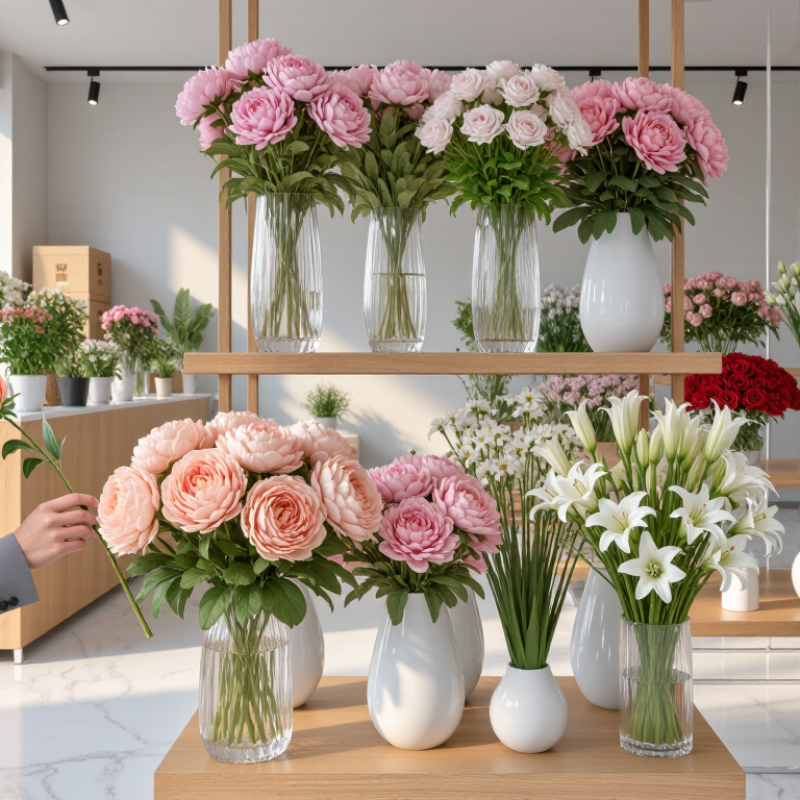
Before comparing colors or prices, define where the flowers will be used and how often they must be handled. A hotel lobby needs durable, dust-friendly arrangements that stay attractive under bright lighting. A wedding supplier may need realistic stems, flexible quantities, and quick turnaround. A small detail, such as narrow vase openings, can affect stem choice.
The Grand View Research report on the artificial flowers market estimated its 2022 global value at USD 1.6 billion. That figure signals a sizable market, but it does not tell you which products suit your customers. Treat it as context, not a purchasing forecast. Test demand with a small range. Track which colors, stem lengths, and price points customers actually request.
Write a simple product brief before ordering: application, target price, expected lifespan, cleaning method, storage space, and order volume. For restaurant tables, compact arrangements may reduce handling and keep sightlines clear. For retail displays, varied heights can create depth from the aisle. Check samples under your actual lighting. Compare leaf texture, wire flexibility, and color consistency across several pieces. One sample is not enough. Also ask suppliers about carton size and lead times; bulky stock can quietly consume valuable storage space. I would revise the brief after each buying cycle. Real customer behavior often differs from the plan.
| Business Need or Intended Use | What to Prioritize | Suitable Product Characteristics | Practical Checks Before Buying |
|---|---|---|---|
| Retail displays and product merchandising | Consistent appearance, easy restocking, and a range of colors and sizes | Repeatable styles, coordinated stems, and shapes that hold their form on display | Check color consistency between samples and bulk orders; confirm stem lengths, pack quantities, and available reorder options. |
| Event styling and short-term installations | Fast setup, portability, and designs that photograph well | Lightweight arrangements or stems that can be repositioned; flexible stems can help with shaping | Test the arrangement under the venue’s lighting and from typical viewing distances. Confirm setup time, packing requirements, and return or reuse plans. |
| Hotels, restaurants, and reception areas | Long-term appearance, straightforward upkeep, and suitability for the installation location | Durable materials and stable arrangements suited to indoor display | Ask how to remove dust and whether the flowers are suitable for the intended location. Keep displays away from heat sources and open flames. |
| Outdoor or semi-outdoor décor | Resistance to local weather and the amount of direct sunlight | Products specifically described by the supplier as suitable for the planned outdoor conditions | Do not assume that an artificial flower is UV-resistant or weatherproof. Check the product documentation and test a sample in the intended setting. |
| Floral design and custom arrangements | Flexibility, realistic proportions, and a useful selection of flower types and foliage | Stems that can be trimmed or shaped, with compatible colors, textures, and scale | Review the stem construction and finish. Confirm whether cutting or bending affects the product and whether replacement stems can be sourced later. |
| Wholesale resale or multi-location purchasing | Reliable supply, consistent specifications, and predictable unit economics | Clearly documented materials, dimensions, case quantities, and ordering terms | Request a sample before committing to volume. Compare landed cost, minimum order quantities, lead times, defect handling, and packaging. |
| Budget-conscious or high-volume decoration | Total cost over the planned use period, not price alone | Simple designs that meet the required viewing distance and can be reused where appropriate | Compare price per usable stem or arrangement, shipping, storage space, and replacement frequency. Inspect finish quality and assembly consistency. |
| Close-up photography or premium client-facing displays | Realistic details, natural-looking color variation, and a convincing shape | Well-finished petals, leaves, and stems; a balanced arrangement with varied forms | Inspect samples in person when possible. Look at them in natural and artificial light, and photograph them at the distances customers are likely to see them. |
Selection tip: Start with the display location, expected viewing distance, maintenance plan, and purchase volume. Request samples and verify product specifications before placing a large order.