
Blog

China Top 10 Bubble Pendant Lamp Manufacturers

A Bubble Pendant Lamp can soften a room without hiding its structure. Its rounded glass catches daylight, then spreads a warmer glow across a dining table or kitchen island. But appearance is only part of the decision. Buyers also need consistent glass quality, secure fittings, suitable light output, and clear product documentation.

This guide to China’s top 10 Bubble Pendant Lamp manufacturers compares makers through practical criteria: design range, material options, production capability, customization, and communication. A polished product photo is not proof of dependable manufacturing. Ask for finish samples, installation details, and lead-time information. Small details matter.

Architect Louis Kahn offered a useful thought about light: “The sun never knew how great it was until it hit the side of a building.” His words concern architecture, yet they also remind us that lighting depends on its surroundings. A pendant’s effect changes with ceiling height, wall color, and the glass’s transparency.

The manufacturers featured here serve different needs. Some prioritize distinctive shapes; others focus on repeatable production or project support. Compare each supplier against your own specifications, not just a ranking. Check how they describe glass thickness, socket compatibility, packaging, and quality checks. A beautiful sphere can still disappoint if its finish varies or its light feels harsh. That deserves a second look. The goal is not simply to find an attractive lamp, but to identify a supplier whose products and process fit the project.
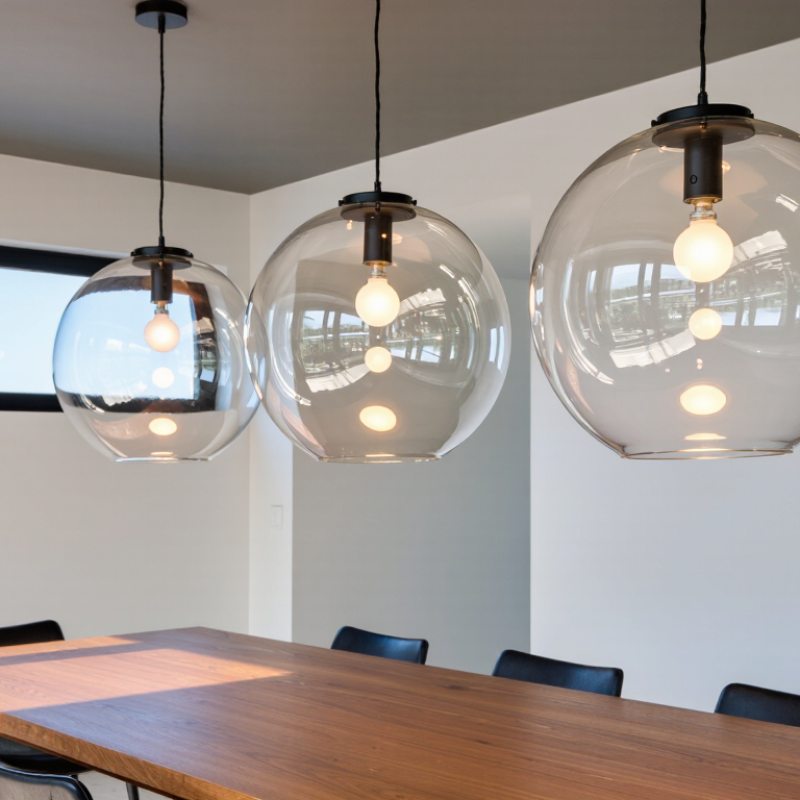
China Top 10 Bubble Pendant Lamp Manufacturers

Bubble Pendant Lamps: Definition, Design, and Key Features

Bubble pendant lamps are suspended fixtures built around one or more rounded shades, often made from clear, frosted, or opal glass. Their bubble-like form softens hard room geometry while keeping the silhouette visually light. A single globe suits a compact dining nook; clustered globes create a focal point above a long table. Glass thickness, opening size, and finish affect glare and cleaning. Clear glass reveals the bulb, which can look crisp but feel harsh at eye level. Not every room needs a cluster.

Good design depends on proportion and light control, not shape alone. Check shade diameter against the table, ceiling height, and nearby sightlines. Frosted glass diffuses light more gently, while clear glass creates stronger highlights on polished surfaces. The U.S. Department of Energy’s Energy Saver guidance reports that residential LEDs use at least 75% less energy and can last up to 25 times longer than incandescent bulbs. Actual savings depend on wattage and use, so check bulb compatibility before choosing a fixture.

Tips: Hang the lowest globe roughly 75–90 cm above a dining table, then check the view while seated. Measure twice. Wipe glass with a lint-free cloth; fingerprints show quickly, and crowded clusters can feel visually heavy. That trade-off is easy to miss in showroom lighting.

China’s Bubble Pendant Lighting Industry and Manufacturing Landscape

China’s bubble pendant lighting industry combines glass shaping, metalwork, electrical assembly, and export-focused production. Manufacturers may specialize in hand-blown shades, repeatable molded forms, or mixed-material fixtures. These choices affect lead times and consistency. A clear glass sphere can reveal tiny bubbles, uneven walls, or seams under bright showroom lighting. Details matter. Buyers should review samples in daylight and check how each shade hangs when fitted to its canopy and cord.

Tips: Ask for glass dimensions, shade weight, socket specifications, and packaging details before placing a bulk order. Confirm that samples match approved drawings. Small differences can change the fixture’s balance and appearance.

Production capacity is only part of the picture. Reliable suppliers document inspection steps, protect fragile shades with fitted inserts, and communicate changes to materials or finishes. For custom projects, clarify tolerances early; “hand-finished” can mean more variation than expected. Not always a problem. Yet it should be discussed before installation schedules are fixed. Requesting a trial shipment can reveal packing weaknesses that photographs do not show. The landscape is broad, and factory capability varies, so evaluate evidence rather than relying on catalog images alone.

How to Assess Bubble Pendant Lamp Manufacturers in China

When assessing bubble pendant lamp manufacturers in China, look beyond catalogue photos. Ask how each glass sphere is formed, checked for bubbles or stress marks, and protected during packing. Request a production sample, then inspect it under warm and cool light. Small differences in glass thickness can change the glow. Ask for written tolerances, material specifications, and test records for the exact model, not just a similar product. Ask for proof.

Check electrical components and documentation separately from decorative quality. The U.S. Department of Energy’s Energy Saver guidance reports that LED bulbs use at least 75% less energy and can last up to 25 times longer than incandescent bulbs. That benchmark concerns LEDs generally, not a particular pendant. A credible supplier should provide component specifications and, where relevant, photometric and electrical test reports. Confirm that the documents match the lamp’s voltage, driver, and configuration.

Then examine how the factory handles repeat orders. Ask for photos of packing tests, inspection checkpoints, replacement-glass procedures, and realistic lead times. A beautifully finished sample is encouraging, but it cannot prove consistent production. I would also request a quotation that separates glass, metalwork, wiring, packaging, and shipping; vague pricing makes comparisons weak. One detail is easy to overlook: clarify who pays when fragile shades arrive damaged. Even experienced buyers sometimes assume this is covered. Get the answer in writing.

Profiles of 10 Leading Chinese Bubble Pendant Lamp Manufacturers

China’s bubble pendant lamp market includes manufacturers with very different strengths. These ten profiles describe useful supplier types, not a verified ranking.

A glass-shaping specialist may offer hand-finished globes, where small variations in thickness affect the light.

A metalwork-focused factory may build sturdy ceiling plates and frames.

An export-oriented OEM supplier often supports custom dimensions and packaging.

A color-focused workshop can match glass samples, though batch consistency needs checking.

A cluster-light manufacturer typically handles several globes on one canopy, making wire length and balance important.

A small-batch producer may welcome unusual layouts but have longer lead times.

A project supplier may coordinate lamps for hotels or restaurants and provide installation drawings.

A design-led maker may offer distinctive proportions, but replacement parts are worth discussing early.

Details matter.

The remaining profiles are a packaging-focused factory, which should protect fragile glass with fitted inserts, and a quality-control-driven producer, which may document checks for wiring, finish, and dimensions.

These are practical distinctions, not guarantees. Ask for current product photos, sample measurements, and written specifications before comparing quotations. Inspect the canopy, sockets, and glass edges closely. Not every finish stays perfect in transit, and that is easy to underestimate. A clear sample review can prevent costly surprises.

Comparing Manufacturer Capabilities, Products, and Services

When comparing China’s bubble pendant lamp manufacturers, look beyond catalog photos. A capable factory should explain how its glass globes are formed, inspected, and matched for color. Ask for globe dimensions, canopy options, cable lengths, and finish samples. Small variations show clearly under warm light. Request a sample before approving a large order. Clear answers matter.

A broad product range is useful only when it fits the project. Some suppliers offer single-globe pendants, clustered fixtures, and adjustable drops; others focus on custom sizes or finishes. Check whether the lamp holders and dimming components suit your intended installation. Confirm voltage options, packaging methods, and replacement-part availability in writing. Details save time later.

Service capability can separate a smooth purchase from a frustrating one. Compare drawing support, sample lead times, inspection records, export packaging, and response speed. Ask how defects are documented and what remedy is offered, rather than relying on broad assurances. A low quotation may exclude testing or stronger packaging. There is no perfect supplier. Compare sample quality with the stated production standard; that step is easy to overlook, and it may not catch every issue.

China Bubble Pendant Lamp Manufacturers: Product Material Comparison

Typical density of materials used in bubble pendant shades and fixture components (approximate values in g/cm³).

Glass is commonly used for bubble-shaped shades, while aluminum and stainless steel are often used in fixture components. Density indicates material mass per unit volume; it does not represent the weight of a finished lamp.