
Blog

Best Professional Card Games Manufacturer in China?

Choosing the Best Professional Card Games Manufacturer in China requires more than comparing factory prices. China remains a major production hub for printed games, supported by mature paper, packaging, and fulfillment networks. Industry forecasts show continued growth across tabletop entertainment. Grand View Research valued the global board games market at approximately USD 13.4 billion in 2023. However, market definitions vary. That detail deserves caution.

A reliable Professional Card Games Manufacturer should demonstrate practical experience with card stock, coating, color control, and automated cutting. Ask for measurable specifications, including paper weight, thickness tolerance, corner radius, and print consistency. A factory sample should survive repeated shuffling without visible edge whitening. It should also match the approved color proof under controlled lighting. Small details matter.

Compliance is equally important. Depending on the destination market, buyers may need ASTM F963, CPSIA, EN 71, REACH, or other applicable testing documentation. FSC-certified materials can support responsible sourcing claims, but certification must be verified. Reports from the International Trade Centre and market research firms also highlight the importance of supply-chain transparency in consumer products. A trustworthy manufacturer should provide factory records, test reports, production photographs, and clear timelines. No supplier is flawless. Even an experienced factory may misjudge a foil finish or underestimate peak-season delays. The right partner acknowledges these risks, explains corrective actions, and protects game quality from prototype to final shipment.
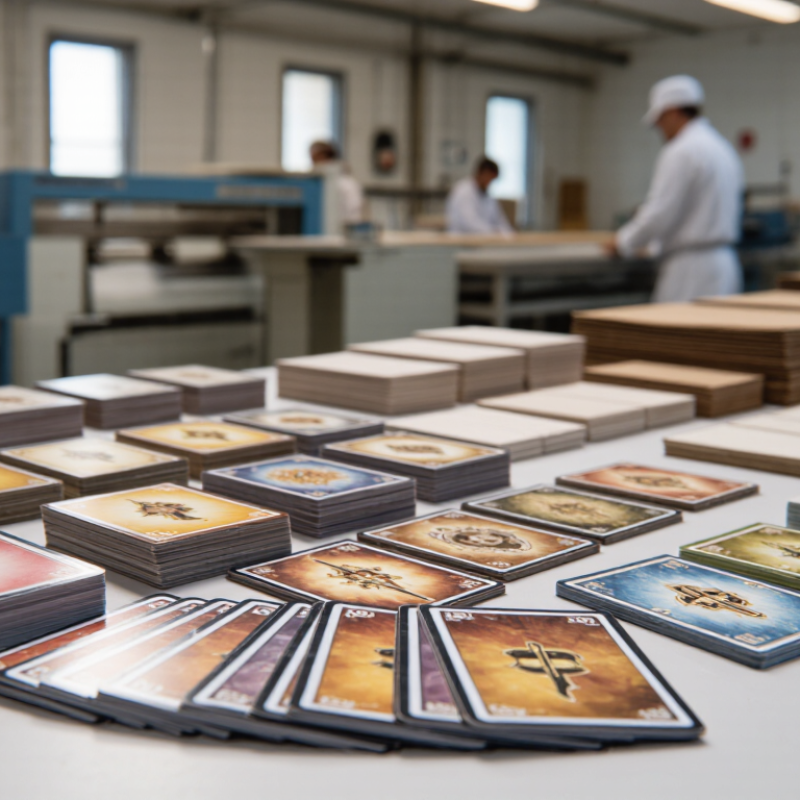
Best Professional Card Games Manufacturer in China?

What Defines a Professional Card Games Manufacturer in China

A professional card games manufacturer in China is defined by more than equipment or a polished factory tour. Real experience appears in small decisions: card stock, coating, corner radius, ink density, and box tolerance. A capable team can explain why a linen finish handles shuffling differently from smooth varnish. It should also show production samples, not only digital renders. Details matter.

Reliable manufacturing begins with a clear technical process. The supplier should confirm file checks, color proofs, material approval, and pre-production samples before mass printing. During production, trained inspectors should check centering, edge cuts, surface marks, and count accuracy. Random carton checks are useful, but they cannot replace in-line inspection. Packaging should protect decks from humidity, pressure, and rough handling. Factory records, batch references, and corrective reports make quality easier to verify.

Professionalism also depends on honest communication. A responsible manufacturer explains minimum order quantities, lead times, tooling costs, and possible delays in plain language. It should understand export documentation and destination-market requirements without making careless promises. Experience helps, but it can also create blind spots. A factory may repeat an old process when a new game needs testing. I would request a pilot run and inspect every card face, seal, and tuck box. Small failures reveal more than polished presentations. Good cooperation leaves room for questions, revisions, and measurable improvement.

Best Professional Card Games Manufacturer in China?

What Defines a Professional Card Games Manufacturer in China

A professional manufacturer should consistently deliver accurate card collation, reliable specifications, and scalable production. The chart below uses the standard Anglo-American poker deck as an objective product baseline: 52 cards, 4 suits, 13 ranks per suit, and up to 2 optional jokers.

These measurable specifications help buyers evaluate whether a supplier has the process control required for professional card game production, including printing accuracy, sorting precision, packaging consistency, and quality inspection.

Core Manufacturing Capabilities and Product Standards

Best Professional Card Games Manufacturer in China?

Core manufacturing capability begins with repeatable control, not attractive samples. A reliable factory checks paper moisture, card thickness, cutting accuracy, ink adhesion, and corner radius. Typical professional cards use 280–350 gsm stock, with tolerances recorded for every production batch. Operators also inspect shuffle feel by hand. Small differences matter.

The 2023 ISO Survey recorded more than 1.2 million ISO 9001 certificates worldwide, showing how widely documented quality systems are used. However, certification alone proves little without inspection records and corrective actions. A capable manufacturer should provide pre-production samples, color references, batch traceability, and final inspection reports. ASTM testing methods can also support checks for coating adhesion, abrasion, and paper performance.

Sustainability needs evidence. FSC’s recent facts and figures report more than 150 million hectares of certified forest worldwide, giving buyers a measurable sourcing reference. Water-based coatings and recyclable paper may reduce environmental impact, but they can change drying time and surface friction. That trade-off deserves testing. No factory is flawless. A missed edge chip or slightly uneven varnish can still appear after packing. Honest suppliers record these failures, investigate the cause, and improve the next run. That habit is more dependable than polished promises.

Best Professional Card Games Manufacturer in China? - Core Manufacturing Capabilities and Product Standards

Evaluation Dimension Professional Manufacturing Capability Typical Product Data or Requirement Relevant Standard or Quality Check
Cardboard Selection Selection of coated playing-card stock, black-core paper, blue-core paper, or specialty board according to the game format. Common playing-card stock is approximately 280–350 gsm; heavier board may be used for oversized cards or premium packaging. Basis weight, caliper, stiffness, moisture content, surface smoothness, and fiber consistency should be checked before production.
Printing Accuracy Offset or digital printing with color management, proof approval, and front-to-back registration control. Commercial card production commonly uses four-color process printing, with optional spot colors and metallic effects. Check color consistency, text legibility, image sharpness, ink coverage, and registration against an approved proof.
Cutting and Corner Rounding Die-cutting and corner rounding designed for smooth handling and consistent card dimensions. Typical poker-size cards measure approximately 63 × 88 mm; bridge-size cards are approximately 57 × 89 mm. Dimensional tolerance, corner radius, edge smoothness, burrs, and deck alignment should be inspected by sampling.
Surface Finish Application of aqueous coating, varnish, lamination, linen texture, matte finish, or gloss finish based on the intended handling experience. Finish selection affects shuffling, friction, glare, scratch resistance, and visual appearance. Evaluate adhesion, rub resistance, blocking, surface uniformity, odor, gloss level, and compatibility with packaging.
Game Component Production Integrated production for cards, instruction sheets, tokens, boards, dice, tuck boxes, rigid boxes, and inserts. Component counts, dimensions, colors, and artwork versions should be defined in a bill of materials before mass production. Use approved samples, component checklists, barcode verification, and quantity reconciliation during packing.
Artwork and Prepress Preflight review for bleed, safe areas, color mode, resolution, dielines, fonts, and variable data. Print files are commonly supplied as press-ready PDF files with embedded fonts or outlined text and defined bleed areas. Artwork approval should include a digital proof and, where color is critical, a physical press proof.
Quality Management Documented inspection procedures covering incoming materials, first articles, in-process production, final packing, and shipment release. AQL sampling may be used for appearance and workmanship inspections; the inspection plan should be agreed before production. ISO 9001 is a recognized quality-management framework, while AQL is a sampling method rather than a product safety certification.
Children’s Product Safety Material review and laboratory testing for products intended for children, depending on the destination market and product classification. Requirements can include limits on lead, phthalates, accessible small parts, sharp points, sharp edges, and flammability. Examples include ASTM F963 and applicable requirements under the U.S. Consumer Product Safety Improvement Act; testing scope depends on the product.
European Market Compliance Preparation of technical documentation and test reports when a card game is marketed as a toy or children’s product in Europe. Age grading, intended use, component materials, and mechanical or chemical risks determine the applicable assessment route. EN 71 may apply to toys; REACH restrictions can apply to substances in articles, inks, coatings, plastics, and packaging.
Paper and Sustainability Options Availability of recycled paper, responsibly sourced paper, water-based coatings, and reduced-plastic packaging options. Sustainability claims should identify the material, percentage, certification scope, and chain-of-custody status. FSC certification applies to certified forest-based materials when the relevant supply chain and claim requirements are met.
Packaging Engineering Design of tuck boxes, rigid boxes, magnetic boxes, trays, shrink wrap, paper seals, and retail-ready cartons. Packaging should protect card edges, prevent movement, support stacking, and provide required product information. Verify box dimensions, closure strength, print quality, barcode readability, drop resistance, and packaging quantity.
Traceability and Documentation Assignment of purchase orders, production batches, material records, inspection reports, and shipment references. A complete file normally includes approved artwork, bill of materials, signed samples, inspection results, and packing records. Traceability supports corrective actions, repeat production, regulatory documentation, and quality investigations.
Pre-Shipment Inspection Final inspection before shipment covering quantity, appearance, functionality, packaging, labeling, and carton condition. Inspection results should distinguish critical, major, and minor defects according to the agreed quality plan. Use a written inspection checklist, approved reference sample, sampling level, defect definitions, and acceptance criteria.

Note: Applicable standards depend on the product design, target age group, materials, labeling, and destination market. Certification and test requirements should be confirmed before production.

How to Evaluate Chinese Card Game Manufacturers

Best Professional Card Games Manufacturer in China?

Evaluating Chinese card game manufacturers requires more than comparing unit prices. Start with production evidence. Ask for factory videos, material specifications, inspection records, and recent export experience. A professional supplier should explain card stock, coating, color tolerance, cutting accuracy, and packaging protection clearly. According to Grand View Research, the global board games market reached approximately USD 13.06 billion in 2023. This growth increases competition, but it also makes quality verification more important.

Request a physical prototype before approving mass production. Check whether cards bend after repeated shuffling, whether edges remain smooth, and whether colors match the approved proof. ISO 2859-1 sampling procedures can support consistent inspection, although they cannot replace practical handling tests. Discuss minimum order quantities, tooling fees, lead times, reprint policies, and factory capacity during peak seasons. A low quotation may hide thinner stock or weaker quality control. That mistake is expensive.

Tips: Use a written specification sheet with measurable requirements. Record card thickness, size tolerance, paper type, coating, corner radius, and color standard. Ask for a pre-shipment inspection report from an independent testing agency. Check worker safety and environmental documentation as well. I would not rely only on a polished showroom or fast replies. Those signals help, but they are incomplete. One overlooked detail can affect thousands of decks. Evaluate communication, samples, data, and corrective actions together.

Customization, Prototyping, and Production Services

Best Professional Card Games Manufacturer in China?

Customization, Prototyping, and Production Services

A professional card game manufacturer should turn rules into reliable physical experiences. Customization begins with card size, paper weight, coating, corners, packaging, and finishing. A prototype can reveal problems that artwork hides, such as weak contrast, slippery cards, or unreadable icons.

According to Grand View Research, the global playing cards market continues to expand, supported by leisure, collecting, and tabletop entertainment demand. Statista Market Insights also reports strong worldwide revenue across card games, although its figures include digital products. Definitions differ. That matters when planning production volumes.

A practical workflow starts with a digital prepress check and a small physical sample. Experienced teams test shuffle feel, color consistency, edge alignment, and box durability. We recommend checking at least three prototype rounds.

Small details matter.

A 300 gsm card may feel premium, yet it can become difficult to shuffle in a large deck. Linen texture improves grip, but it may soften fine illustrations. These trade-offs require testing, not assumptions. The International Organization for Standardization’s quality principles emphasize repeatable processes and documented inspections. Manufacturers should therefore provide color proofs, production samples, material specifications, and measurable tolerance standards.

Cost estimates can also mislead. A low unit price may exclude tooling, inserts, quality checks, or export packaging. We sometimes see clients approve artwork too early. That is a preventable mistake, but not a rare one. A dependable production partner explains limits clearly, records revisions, and keeps samples for comparison during mass production.

Quality Control, Certifications, and Global Logistics

For professional card games, quality control starts before the cards reach the press. A clear specification should cover card size, paper weight, surface finish, color tolerance, and packaging. During production, inspectors can compare printed sheets with an approved sample, check cut edges, and shuffle cards to spot sticking or uneven wear. Small details matter. A slightly off-center image may seem minor, but it becomes obvious across a full deck. No checklist catches everything, so factories should record defects and explain how they were corrected.

Certifications and test reports are useful only when their scope is clear and current. Buyers can verify the issuing body, covered site, and relevant production processes instead of relying on a logo alone. Ask for batch records and inspection results tied to the actual order. For global logistics, confirm carton dimensions, gross weight, labeling, and shipping documents before dispatch. Moisture protection matters; damp cartons can warp cards during a long journey. A sample shipment can reveal packing weaknesses, though it adds time and cost. That trade-off deserves an honest discussion. Even careful planning cannot prevent every delay, so realistic lead times and clear updates help keep expectations grounded.