China Best Clothes Wardrobe Manufacturers for Global Buyers
Choosing a Clothes Wardrobe manufacturer in China involves more than comparing prices. Global buyers need to examine materials, construction, communication, and the supplier’s ability to meet specific project requirements. A wardrobe may look polished in a product photo. The real test comes when its doors align, drawers slide smoothly, and finish remains consistent across an order.
Design thinker William Morris offered a useful principle: “Have nothing in your houses that you do not know to be useful or believe to be beautiful.” For buyers, that means assessing both function and appearance. Ask about board thickness, edge treatment, hardware options, packaging, and quality checks. Request clear specifications and product samples when possible. Details matter.
China’s furniture supply network serves buyers with different budgets and needs, but manufacturers are not interchangeable. Some focus on custom dimensions; others offer established product lines and larger production capacity. Verify claims directly. Review factory information, request recent project references, and clarify timelines before placing an order. A careful conversation can reveal more than a glossy catalogue.
This guide looks at manufacturers through practical buying questions, not rankings alone. It considers product range, customization, quality controls, and export experience. Not every detail will be easy to verify. That is worth admitting. A thoughtful buyer should compare evidence, ask follow-up questions, and leave room for unexpected delays. The best partnership is rarely the one with the boldest promise.
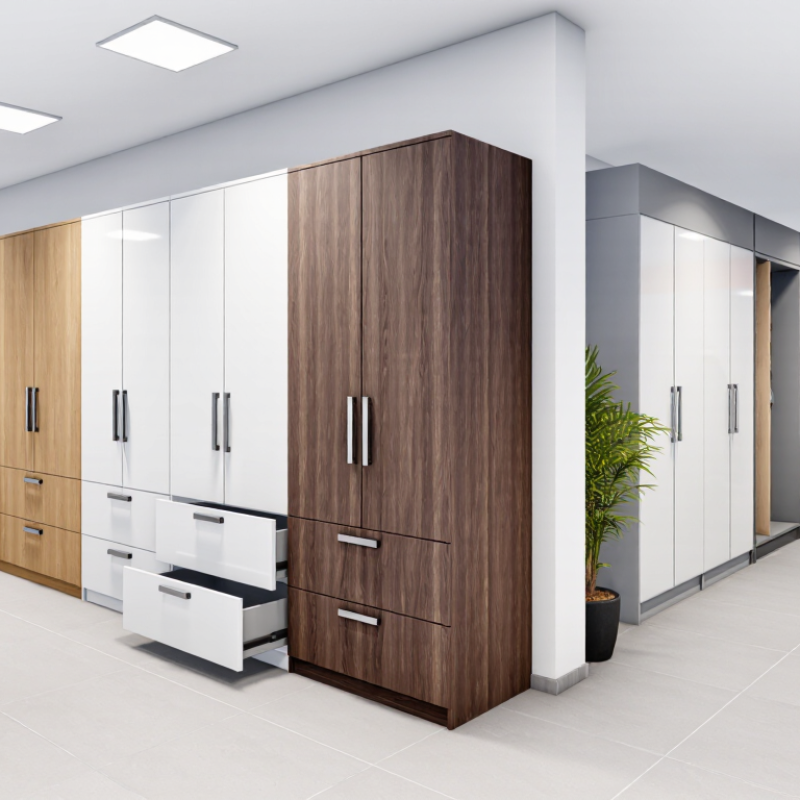
Overview of China’s Clothes Wardrobe Manufacturing Industry
China’s clothes-wardrobe manufacturing industry sits within the broader furniture sector, so public statistics rarely isolate wardrobe production. The National Bureau of Statistics reported that furniture manufacturers above designated size recorded RMB 655.7 billion in operating revenue in 2023, down 4.4% year on year. This is useful context, not a wardrobe-market estimate. China Customs trade tables likewise group furniture and parts broadly, making product-level export comparisons difficult.
Production commonly combines panel cutting, edge banding, drilling, assembly, and surface finishing. A buyer inspecting a sample should check drawer alignment, door gaps, hardware movement, and the finish inside exposed edges. Small defects matter. Cabinet dimensions, board thickness, packaging, and assembly instructions should be confirmed in written specifications before production. Factories may offer flexible configurations, but customization can complicate repeat orders and quality checks. That trade-off deserves attention.
Industry scale does not guarantee consistent workmanship. Moisture changes during transport, uneven wall measurements, and poorly protected corners can affect installation and product condition. China’s National Furniture Association and national statistical releases provide useful sector context, but neither should be treated as proof of an individual factory’s capacity. Buyers still need to review current samples, production records, and inspection procedures. A rushed approval is risky.
Major Manufacturing Regions and Their Capabilities
China’s wardrobe manufacturing network is spread across several industrial regions, each with different strengths. Guangdong, particularly Foshan and nearby cities, has a dense supply chain for cabinet panels, hinges, sliding-door tracks, and surface finishes. Buyers can often source multiple components within a short transport distance. This can simplify coordination, though supplier density alone does not guarantee consistent quality.
Zhejiang is known for efficient panel processing and modular furniture production. Its factories may suit projects that need repeatable dimensions, flat-pack designs, or varied interior layouts. Jiangsu and neighboring areas offer access to established woodworking, machinery, and logistics networks. Capabilities differ between factories, even within the same region. Details matter.
When comparing locations, ask for samples that show edge sealing, drilled-hole accuracy, and the feel of drawer runners. A wardrobe can look polished in a showroom but reveal uneven gaps after installation. Check how the factory controls board moisture, protects corners during packing, and confirms measurements before production. These checks are practical, not perfect. I would also compare lead-time records with the proposed schedule, since seasonal demand can disrupt even well-organized production.
China Best Clothes Wardrobe Manufacturers for Global Buyers - Major Manufacturing Regions and Their Capabilities | Manufacturing Region | Key Furniture Areas | Common Wardrobe Capabilities | Potential Strengths for Global Buyers | Sourcing Considerations |
| Guangdong | Foshan, Guangzhou, Dongguan and nearby manufacturing areas | Made-to-measure and modular wardrobes; sliding- and hinged-door systems; panel furniture; coordinated bedroom furniture; a range of surface finishes and hardware options. | A broad furniture and component supply base, with access to domestic transport links and major export gateways in the Pearl River Delta. | Confirm the factory’s actual production scope, export experience, material specifications and ability to meet the destination market’s safety requirements. |
| Zhejiang | Ningbo, Hangzhou and surrounding industrial areas | Panel-based and modular storage furniture; wardrobes made with engineered wood; options for different door styles, internal layouts and finishes. | A diverse manufacturing and home-furnishing supply base. Capabilities differ across cities and individual suppliers. | Request current samples and a detailed bill of materials. Verify which components are made in-house and which are sourced from subcontractors. |
| Jiangsu | Furniture-producing areas around cities such as Suzhou, Nantong and Changzhou | Residential storage and bedroom furniture, including panel wardrobes and modular configurations; some suppliers also offer custom dimensions and interior fittings. | Useful for buyers comparing a range of furniture styles and production arrangements within the Yangtze River Delta. | Check production capacity, lead-time assumptions and quality-control procedures for the specific wardrobe model rather than relying on regional reputation. |
| Sichuan | Chengdu and the Chongzhou furniture manufacturing area | Household furniture and storage products, including panel-based wardrobes and bedroom furniture; some manufacturers provide project-specific or customized options. | Can be considered by buyers sourcing from western China or evaluating suppliers serving regional residential and project markets. | Compare inland transport costs and transit times with coastal alternatives. Confirm the supplier’s arrangements for export packing and international shipment. |
| Shandong | Furniture-producing areas including Qingdao and other regional manufacturing centres | Residential furniture and storage products, with capabilities that may include panel wardrobes, bedroom sets and configurable storage layouts. | Offers another regional sourcing option for buyers comparing product specifications, pricing and logistics across China. | Ask for product-specific evidence of material compliance, finish durability, packaging protection and performance of hinges and drawer slides. |
Buyer note: Regional capabilities are general industry patterns, not guarantees about individual suppliers. Verify factory facilities, materials, certifications, production samples, inspection arrangements and delivery terms before placing an order.
How to Evaluate Chinese Wardrobe Manufacturers
Evaluating a Chinese wardrobe manufacturer starts with the product, not the catalogue. Request technical drawings that show dimensions, board thickness, back-panel construction, and hardware specifications. Check whether the proposed materials match your intended market and use. Ask for finish samples under natural and indoor light. Color can shift.
A sample reveals useful details. Open and close the doors repeatedly, inspect the edge banding, and check whether drawers slide smoothly when loaded. Ask how the factory checks dimensions, surface defects, and packing before shipment. Request records or photos from a recent inspection, where available. A polished sample is encouraging, but it does not prove every production batch will match. I would not treat it as proof.
Discuss production capacity, sample approval, lead times, and packaging in writing. Confirm how cartons protect corners and panels during handling, and whether spare fittings can be supplied. Clear answers matter. Notice how quickly the team flags a specification conflict; silence is not always agreement. If possible, arrange an independent factory or pre-shipment inspection. Small checks help. Compare the quoted price with the materials, hardware, and service included, rather than choosing on price alone. One detail is easy to miss: confirm who approves any change after the sample stage.
Materials, Customization, and Production Standards
For global buyers, wardrobe quality starts with materials suited to the room and shipping route. Solid wood offers a substantial feel, while engineered panels can provide more consistent dimensions and cost control. Request panel-thickness details, edge-band samples, hardware specifications, and finish swatches. A glossy sample can hide uneven edges. Details matter.
Customization works best when measurements and options are recorded clearly. Share drawings with overall dimensions, shelf spacing, door swing, and cable or ventilation needs. Confirm whether changes affect tooling, minimum order quantities, or lead times. A useful review checks that handles, hinges, and drawer runners remain accessible after installation. Small omissions can create costly rework.
Production standards should be verifiable, not just promised. Ask how factories inspect incoming panels, check dimensions, test hardware cycles, and protect corners for transport. Agree on acceptable color variation and defect limits before production, then review a pre-shipment inspection report. Standards can differ between suppliers, so compare actual records rather than relying on a certificate alone. Even detailed checklists miss things; buyers should leave room for follow-up questions.
Sourcing, Quality Control, and International Logistics
Global wardrobe sourcing starts with a specification that factories can measure. State panel thickness, board grade, finish, edge-band width, hardware, and carton dimensions. Ask for a production sample before approving bulk orders. Check door alignment, hinge movement, shelf loading, and sharp edges on assembled units. Small details matter. A pre-shipment inspection should compare random cartons with the approved sample, not just review photographs. Still, inspections can miss problems that appear after repeated assembly; record defects and revise the next order.
Quality also depends on clear logistics planning. UNCTAD’s Review of Maritime Transport 2024 notes that more than 80% of world merchandise trade by volume moves by sea. For bulky wardrobes, measure packed cartons and calculate container loading before confirming prices. Protect corners, separate fittings, and use moisture-resistant packaging for long voyages. The World Bank’s 2023 Logistics Performance Index assesses 139 economies across areas including tracking, infrastructure, and timeliness. These factors affect delivery reliability, but a strong score cannot prevent every port delay. Share carton counts, shipping marks, and document deadlines with the supplier and forwarder early. One missed detail can leave installation teams waiting.