Blog

2026 Top Custom Rubber Springs Suppliers for Global Buyers

Choosing a Custom Rubber Springs Supplier in 2026 requires more than comparing unit prices. Global buyers need dependable performance, clear communication, and evidence behind every technical claim.

This guide examines suppliers that support custom rubber spring development for industrial equipment, vehicles, machinery, and vibration-control systems. It considers material selection, load requirements, compression limits, operating temperatures, and environmental exposure. A reliable supplier should review drawings carefully, ask practical questions, and explain design risks before production begins. Prototype samples matter. A spring that looks correct on paper may behave differently under repeated compression.

Manufacturing experience also deserves close attention. Look for documented inspection procedures, batch traceability, dimensional reports, and relevant quality certifications. Testing may include load-deflection checks, compression-set evaluation, fatigue trials, and temperature resistance. These details help buyers compare suppliers with greater confidence across different regions and industries. Delivery capability matters too, especially when tooling, sampling, packaging, and export documentation affect project schedules.

No supplier is perfect.

Even experienced manufacturers can miss a requirement when specifications remain vague. Buyers should therefore confirm tolerances, rubber compounds, surface finishes, tooling ownership, and acceptance standards in writing. This review is designed to support that process with a practical, evidence-based perspective. It does not treat marketing language as proof. Instead, it focuses on capability, consistency, technical support, and long-term reliability. Some rankings may still require further verification, because supplier performance can change with capacity, materials, and management.

2026 Top Custom Rubber Springs Suppliers for Global Buyers

What Custom Rubber Springs Are and How They Function

Custom rubber springs are elastic components designed for a specific load, movement, and installation space. They can support weight, absorb vibration, and control unwanted motion. Unlike metal springs, they work through the controlled deformation of rubber compounds.

A rubber spring may compress vertically, twist in shear, or combine both movements. During operation, its rubber body stores mechanical energy and releases it gradually. This reduces shock between moving parts. A custom shape can include bonded metal plates, mounting holes, or tapered sections. Each feature changes stiffness and load distribution.

Material selection requires practical testing. Engineers examine hardness, fatigue resistance, temperature range, oil exposure, and dynamic stiffness. A spring used near a hot motor needs different rubber than one used outdoors in cold weather. Small changes matter. Even a slight bonding defect can create uneven stress and early failure. Compression tests, endurance cycles, and dimensional checks help confirm reliability.

In equipment inspections, the most useful clues are often visible. Cracks around metal inserts, permanent deformation, and unusual noise may indicate overload. However, appearance alone cannot reveal internal fatigue. A drawing can look correct, yet the spring may perform poorly after thousands of cycles. Design reviews should therefore include real load data, installation tolerances, and maintenance conditions. The first prototype is rarely perfect. Careful adjustment remains part of responsible engineering.

Key Materials, Designs, and Performance Requirements

Material selection defines how a custom rubber spring behaves in real service. Natural rubber offers strong resilience and excellent fatigue resistance. EPDM suits outdoor systems exposed to ozone, moisture, and sunlight. NBR performs better around petroleum oils, while silicone handles wider temperature ranges. Each compound needs a verified hardness, tensile strength, and compression-set target. Small details matter.

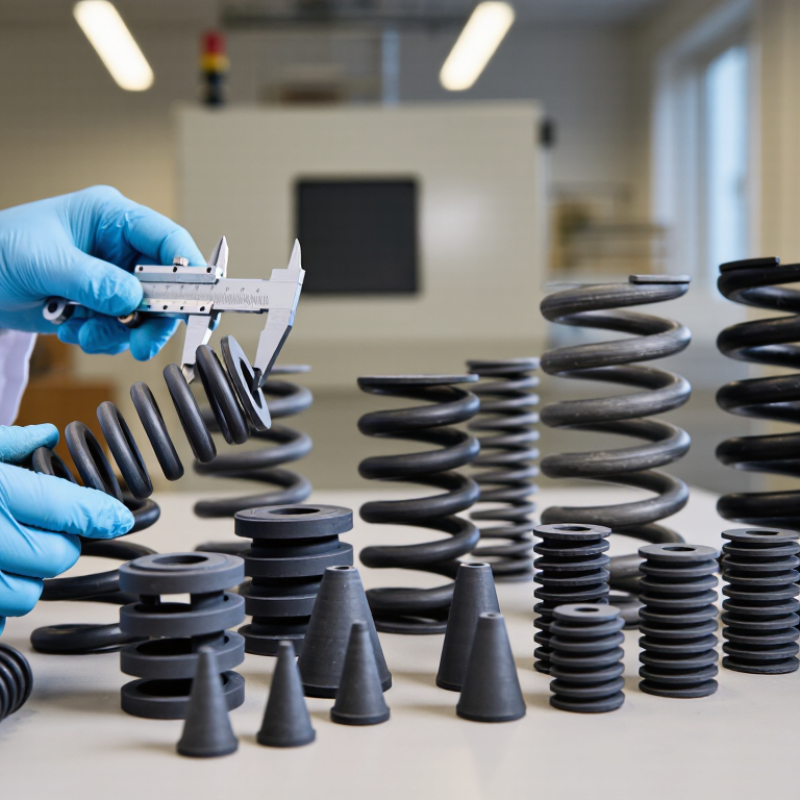
Design choices should match the applied load and movement direction. Cylindrical springs support compression loads with predictable deflection. Conical profiles can reduce stress concentration near the end plates. Shear and bonded designs manage lateral movement more effectively. Laminated structures may provide controlled stiffness in compact spaces. Fit is not performance. A spring that matches the drawing can still fail under heat, vibration, or uneven loading.

Reliable suppliers should provide load-deflection curves, fatigue data, material certificates, and dimensional inspection records. Ask for samples tested under the actual temperature, frequency, and travel range. A laboratory result at room temperature may not represent field conditions. Surface preparation and bonding quality also deserve close inspection. In production reviews, small mold variations often change spring rate more than expected. That risk is easy to underestimate. Clear tolerances, batch traceability, and realistic validation plans help global buyers compare suppliers with greater confidence.

How to Evaluate Custom Rubber Spring Suppliers

Evaluating custom rubber spring suppliers starts with application evidence, not attractive catalogs. The International Rubber Study Group’s 2024 outlook placed global rubber demand near 31.7 million tonnes, increasing pressure on material consistency and production capacity. Ask suppliers for compound specifications, hardness tolerance, compression-set results, and fatigue data at your actual temperature range. A generic load chart is not enough.

Request samples made from the proposed compound and tooling process. Measure spring rate, rebound, dimensional stability, and permanent deformation after cycling. ASTM D395 supports compression-set testing, while ASTM D412 helps assess tensile properties. For quality systems, verify current ISO 9001 certification, calibration records, traceability, and corrective-action reports. Audit the factory if order volume justifies travel. Small details matter.

Do not trust perfect samples alone. Production drift happens. Compare at least three batches, including one from normal production conditions. Check whether the supplier can maintain tolerances after mold wear, compound changes, or seasonal humidity. The 2024 Smithers review of the rubber industry highlights continuing cost and supply volatility, so confirm backup material sources and realistic lead times. A low quotation may conceal weak testing or unstable tooling. That deserves a hard question. Suppliers should explain failures clearly, not only display successful reports. Reliability is demonstrated repeatedly, under load, over time.

Manufacturing, Testing, and Quality Control Standards

Global buyers need more than a low unit price. Custom rubber springs must withstand repeated compression, heat, oil, ozone, and dimensional drift. The International Rubber Study Group’s 2024 outlook placed worldwide rubber demand near 30 million tonnes annually. That scale increases pressure on suppliers to prove consistency, not merely production capacity.

Reliable manufacturing begins with controlled compounds and traceable batches. Suppliers should document polymer type, filler content, curing temperature, pressure, and mold conditions. ISO 9001 systems help structure these records. The ISO Survey 2023 reported 1,265,216 ISO 9001 certificates worldwide, showing how widely quality management has been adopted. Still, certification alone is not enough. A clean certificate cannot repair poor mold design.

Testing should match the spring’s working environment. ISO 37 evaluates tensile properties, while ISO 815-1 measures compression set. ISO 188 supports accelerated heat-aging checks. ISO 1817 examines resistance to selected fluids, and ISO 48-4 measures hardness. Dimensional inspection should follow defined tolerances, using calibrated gauges and recorded sampling plans. Production teams should also run fatigue cycles with real load conditions. Lab results can look excellent. Field behavior may disagree.

Quality control works best when failed samples remain visible. Suppliers should retain specimens, record nonconformities, and investigate recurring mold marks or uneven curing. Buyers should request inspection reports, batch traceability, material declarations, and corrective-action records. Some specifications remain incomplete. That is worth challenging before mass production.

2026 Top Custom Rubber Springs Suppliers for Global Buyers - Manufacturing, Testing, and Quality Control Standards

Buyer-Oriented Reference Matrix for Custom Rubber Spring Manufacturing and Supplier Qualification

Evaluation Dimension Manufacturing or Technical Requirement Relevant International Standard or Method Typical Quality-Control Data Recommended Supplier Evidence Buyer Priority
Material Formulation Compound selection should match the operating temperature, fluid exposure, ozone environment, dynamic loading, and required fatigue life. ASTM D2000 may be used to classify rubber materials by physical properties and resistance requirements. Polymer family, hardness range, tensile strength, elongation, compression set, temperature range, and fluid-resistance data. Approved compound specification, material safety documentation, batch traceability, and certificate of analysis. Critical
Dimensional Design Spring geometry should define outside diameter, inside diameter, free height, end configuration, load direction, and allowable deflection. ISO 3302-1 provides dimensional tolerance classes for moulded solid rubber products. Drawing revision, nominal dimensions, tolerance class, concentricity, flatness, and measured dimensional results. Controlled engineering drawing, inspection plan, first-article report, and calibrated measurement records. Critical
Load and Deflection Performance Load-deflection behavior should be verified at the specified displacement, loading rate, temperature, and installation condition. Testing is normally defined by the customer specification or validated internal method; compression testing principles may be based on ASTM D575. Load at defined deflection, stiffness curve, hysteresis, permanent set, and acceptance limits. Force-displacement curves, test-fixture drawings, equipment calibration records, and sample identification. Critical
Hardness Control Rubber hardness must remain within the approved compound and product specification because it directly affects spring rate and load capacity. ASTM D2240 or ISO 7619-1 for hardness measurement using a durometer. Shore A hardness, measurement locations, conditioning time, number of readings, and permitted variation. Batch test report, durometer calibration certificate, and retained reference samples where required. High
Tensile and Elongation Properties Material strength and extensibility should be suitable for compression, shear, handling, and any combined-load condition. ASTM D412 or ISO 37 for tensile strength, elongation at break, and related tensile properties. Tensile strength, elongation at break, specimen type, test speed, conditioning, and failure mode. Laboratory test report linked to the compound batch and applicable material specification. High
Compression Set Low compression set is important when the rubber spring must maintain sealing force or load recovery after long-term compression. ASTM D395 or ISO 815-1 for compression-set testing. Compression-set percentage, test method, temperature, duration, specimen dimensions, and recovery period. Routine batch results and separate validation data at the customer’s specified temperature and duration. High
Thermal Aging Accelerated aging should confirm retention of hardness, tensile strength, elongation, dimensions, and load performance after heat exposure. ASTM D573 or ISO 188 for accelerated aging in air ovens. Change in hardness, tensile strength, elongation, mass, dimensions, and load-deflection performance. Before-and-after test comparison, aging profile, oven calibration, and defined acceptance criteria. High
Fluid Compatibility Where exposure is expected, the compound must be validated against oils, fuels, hydraulic fluids, coolants, cleaning agents, or other specified media. ASTM D471 or ISO 1817 for determining the effect of liquids on vulcanized rubber. Volume change, mass change, hardness change, tensile-property change, swelling, cracking, and visual condition. Fluid list, exposure conditions, test photographs, post-exposure measurements, and material compatibility statement. Application-Based
Ozone and Weather Resistance Outdoor or exposed applications should evaluate ozone cracking and weathering resistance using the actual compound and surface condition. ASTM D1149 or ISO 1431-1 for ozone resistance of vulcanized rubber. Ozone concentration, exposure duration, strain condition, temperature, crack rating, and visual inspection results. Ozone-test report, environmental chamber calibration, and defined visual acceptance criteria. Application-Based
Dynamic Fatigue Repeated compression, shear, or combined loading should be tested to represent the expected service cycle and installation constraints. Use a documented, validated fatigue method agreed by the buyer and manufacturer; the method must reflect the actual load spectrum. Cycle count, load loss, stiffness change, crack growth, temperature rise, permanent deformation, and failure mode. Fatigue protocol, fixture validation, cycle data, failure analysis, and representative production samples. Critical
Moulding Process Compression, transfer, or injection moulding parameters should be controlled for temperature, pressure, cure time, venting, and cavity consistency. Process controls should be documented within the supplier’s quality-management system, commonly aligned with ISO 9001. Mould temperature, cure time, pressure, cavity number, flash level, cure-state verification, and process deviations. Process-control plan, mould-maintenance records, parameter logs, and nonconformance procedures. Critical
Bonding and Inserts Metal or polymer inserts require controlled surface preparation, adhesive application, positioning, cure, and bond-strength verification. Use a validated customer or supplier method for bonded assemblies; inspection criteria should be included in the product specification. Insert material, coating, surface preparation, adhesive lot, bond-line condition, pull or torque strength, and failure mode. Bonding work instruction, adhesive traceability, surface-treatment records, and destructive validation results. Application-Based
Surface and Visual Inspection Finished springs should be free from critical cracks, cuts, blisters, foreign material, exposed reinforcement, severe mould damage, and unacceptable flash. ISO 3302-1 may support dimensional tolerance selection; visual limits should be defined by an approved inspection standard or drawing. Defect type, defect size, location, flash height, surface condition, colour uniformity, and disposition status. Visual inspection standard, operator training record, lighting requirements, defect samples, and inspection checklist. High
Traceability Every production lot should be traceable to the compound batch, mould, machine, production date, operator, inspection results, and shipment records. Traceability procedures should be defined within the supplier’s documented quality-management system, commonly aligned with ISO 9001. Lot number, compound batch, mould cavity, production date, inspection status, and packaging identification. Digital or paper traceability records retained for the period agreed in the purchase contract. Critical
Measurement System Control Gauges and test equipment must be suitable for the tolerance and performance range, regularly calibrated, and protected from unauthorized adjustment. ISO 9001 quality-system requirements and ISO/IEC 17025 principles are commonly used for laboratory competence and calibration control. Calibration status, measurement uncertainty, gauge repeatability, reproducibility, and equipment identification. Calibration certificates, measurement-system studies, laboratory scope, and corrective-action records. High
Nonconforming Product Control Defective material and finished products should be identified, segregated, reviewed, and dispositioned to prevent unintended shipment. ISO 9001 provides a recognized framework for control of nonconforming outputs and corrective action. Nonconformance code, quantity affected, root cause, containment action, corrective action, and effectiveness verification. 8D or equivalent corrective-action report, quarantine records, rework authorization, and closure evidence. High
Pre-Shipment Inspection Final release should confirm product identity, quantity, dimensions, appearance, packaging, labelling, and all agreed performance checks. Inspection sampling should be agreed in the purchase specification; statistical sampling may reference ISO 2859-1 when applicable. Inspection level, acceptance quality limit, sample size, pass/fail results, shipment quantity, and release authorization. Final inspection report, certificate of conformity, packing list, photographs, and retained samples where required. Critical
Packaging and Storage Packaging should protect rubber springs from ozone, ultraviolet exposure, heat, contamination, deformation, and excessive compression during transport and storage. Storage conditions should follow the agreed product specification and recognized rubber-storage practices; packaging requirements should be documented contractually. Storage temperature, humidity limits, shelf-life date, packaging material, stacking method, and FIFO controls. Packaging specification, storage instruction, shelf-life declaration, and shipment-condition records. High
Environmental and Regulatory Compliance Material declarations and restricted-substance controls should match the destination market and the application’s regulatory requirements. Applicable requirements may include REACH and RoHS for relevant products and markets; applicability must be confirmed for the specific use. Substance declaration, supplier material disclosure, restricted-substance screening, and compliance status. Signed compliance declaration, supporting laboratory report where required, and change-notification procedure. Application-Based

Note: Standards and acceptance limits should be confirmed against the latest applicable edition, product drawing, operating environment, and purchase specification. A standard reference does not replace application-specific validation.

Global Sourcing, Compliance, Pricing, and Logistics Considerations

2026 Top Custom Rubber Springs Suppliers for Global Buyers

Global sourcing starts with technical clarity, not a supplier directory. Share drawings, load ranges, deflection limits, rubber grade, and operating temperatures. A sample should match production materials, not only its appearance. Ask for batch traceability, inspection records, and corrective-action procedures. Factory audits can reveal aging presses, weak mold maintenance, or inconsistent compound storage. Small details matter.

Compliance requirements differ by destination and application. Request declarations for relevant chemical, environmental, and product standards. Confirm whether testing covers the finished rubber spring, coatings, adhesives, and metal inserts. ISO certification can support confidence, but it does not replace product-specific evidence. Buyers should also verify labeling, technical files, and customs documentation before shipment. Requirements are easy to assume incorrectly.

Pricing needs a full-cost view. Compare tooling, samples, testing, packaging, minimum order quantities, payment terms, and transport under the same Incoterm. A low unit price may hide expensive molds or repeated inspections. For logistics, protect springs from ozone, sunlight, moisture, and compression during storage. Use export cartons with clear part numbers and production dates. Check shelf-life guidance before placing large orders. Air freight may solve an urgent shortage, while sea freight usually suits stable replenishment. Lead times still move unexpectedly. Build a realistic buffer. Mistakes happen, even with experienced teams. Rechecking the purchase order can prevent a costly mismatch.